The real challenge is this: Which technology actually suits your room and usage?
Many buyers overspend on features they never use, while others buy underpowered systems that fail to deliver impact.
This guide will help you make a clear, practical, technology-based decision.
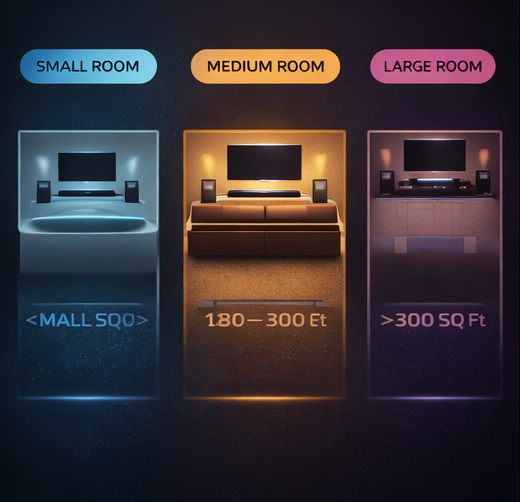
Step 1 — Understand Your Room Size First
Room size is the most important factor affecting sound performance. Sound waves behave differently in small, medium, and large spaces.
Small Room (Bedroom / Study)
In smaller rooms, sound reflects quickly from walls and furniture. This naturally enhances fullness even with simpler systems.
Best Technology Choice
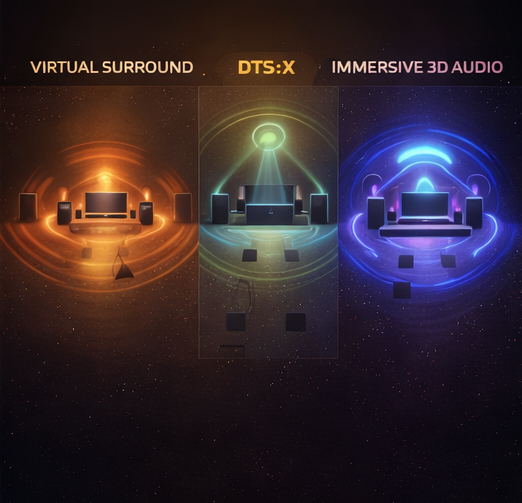
- Virtual surround sound or entry immersive audio
- 2.1 or 3.1 channel soundbar
- Compact active subwoofer
Why This Works
- Reflections help simulate surround effect
- Too many speakers can create audio congestion
- Large subwoofer may produce overpowering bass
Avoid
- High channel surround systems
- Oversized subwoofers
Medium Room (Living Room)
Medium rooms provide the best balance for surround sound. There is enough distance for directional audio without losing clarity.
Best Technology Choice
- True surround system with height simulation
- Wireless rear speakers
- Medium-size active subwoofer
Why This Works
- Rear speakers create realistic immersion
- Bass spreads evenly across the room
- Spatial sound effects become more noticeable
This category offers the highest performance-to-price value.
Large Room or Open Hall
Large spaces require stronger audio systems because sound dissipates faster.
Best Technology Choice
- High-power immersive surround system
- Larger driver size and higher amplifier output
- Large cabinet subwoofer
Why This Works
- Stronger amplification maintains clarity at distance
- Bigger subwoofer moves more air for impactful bass
- Advanced surround processing performs better in spacious environments
Avoid
- Basic virtual surround systems (often sound weak)
Step 2 — Choose Based on Usage Priority
Technology choice should also depend on how you mainly use your TV or entertainment setup.
Movie Watching
Films are designed with multi-directional sound effects. Explosions, background ambience, and movement rely on surround positioning.
Recommended Features
- True rear speakers
- Height-effect capable drivers
- Deep active subwoofer
This setup creates a cinema-like soundstage at home.
Music Listening
Music focuses more on clarity, balance, and controlled bass rather than surround effects.
Recommended Features
- Strong stereo imaging
- Clean midrange tuning
- Tight bass response
Sometimes a well-tuned 2.1 or 3.1 system performs better for music than an entry-level surround system.
OTT Streaming and Casual Viewing
Streaming platforms often use compressed audio formats. Advanced surround technologies may not show full benefits.
Recommended Features
- Virtual surround processing
- Dialogue enhancement modes
- Moderate bass tuning
This ensures comfortable everyday listening.
Gaming
Gaming requires accurate directional sound and low latency.
Recommended Features
- Wired surround speakers or optimized wireless systems
- Fast audio response
- Clear positional cues
This improves awareness in action or competitive games.
Step 3 — Decide Between Wired and Wireless Rear Speakers
Rear speakers are essential for real surround sound, but installation preference matters.
Wired Rear Speakers
Advantages
- Stable signal transmission
- Minimal audio delay
- Reliable for gaming and high-quality audio
Disadvantages
- Cable management challenges
- Fixed placement options
Best for permanent home theatre setups where performance is the main goal.
Wireless Rear Speakers
Advantages
- Cleaner room aesthetics
- Easier installation
- Flexible placement
Disadvantages
- Requires nearby power outlets
- Possible interference in crowded wireless environments
Best for modern apartments and users who prefer convenience.
Step 4 — Understand Subwoofer Technology
Bass performance significantly impacts overall audio experience.
Active Subwoofer
Active subwoofers include built-in amplifiers and digital tuning.
Benefits
- Deep and powerful bass
- Plug-and-play operation
- Optimized integration with soundbar
This is the best option for most home users.
Passive Subwoofer
Passive subwoofers need an external amplifier.
Benefits
- Greater customization potential
- Preferred in modular high-end systems
Challenges
- Complex setup
- Not beginner-friendly
Suitable mainly for audio enthusiasts building custom setups.
Step 5 — Consider Installation and Placement
Even the best technology cannot perform well with poor placement.
Important Guidelines
- Position soundbar at ear level
- Place rear speakers slightly behind seating area
- Avoid blocking subwoofer with furniture
- Maintain proper listening distance
- Flat ceilings improve height-effect performance
Room acoustics like curtains, carpets, and wall materials also affect sound reflection and clarity.
Step 6 — Avoid Common Buying Mistakes
- Choosing high channel count without checking room size
- Expecting true surround sound from a single-bar virtual system
- Buying extremely powerful subwoofer for small rooms
- Ignoring content type (movies vs music vs OTT)
- Overpaying for advanced technology rarely used
Smart buyers focus on balanced technology selection rather than marketing specifications.
Final Decision Framework
Before purchasing a soundbar, ask:
- What is my room size and layout?
- How far do I sit from the TV?
- Do I mainly watch movies, music, or casual content?
- Can I manage wiring for rear speakers?
- How important is strong bass performance?
- Do I plan to upgrade the system later?
Matching these answers with the right technology ensures:
- Better immersion
- Clear dialogue
- Controlled bass
- Long-term satisfaction
Conclusion
Choosing soundbar technology is not about buying the most advanced system. It is about selecting the most suitable audio engineering solution for your environment and lifestyle.
A properly matched system delivers cinematic enjoyment and everyday comfort. A mismatched system leads to wasted money and disappointment.
Focus on room size, usage pattern, and installation preference — and you will make a confident, smart purchase decision.